


From Fiji Times Online (15 June 2008)
Emily Erasito: Proud to be Rotuman
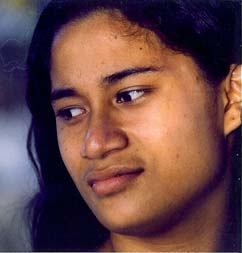 |
Emily Erasito as Hanisi in The Land Has Eyes |
EMILY Akata Erasito is one of the many young Rotuman women who now live in Fiji.
Emily, 21, is from the village of Malsa'a in Hapmak. She now lives in Suva where she studies at the University of the South Pacific.
She was in Rotuma last month for the Rotuma Day celebrations as a representative of the National Advisory Board and Provincial Youth of the Fiji Islands.
Better known for her role in the Rotuman movie The land has eyes, Emily is now keen to highlight problems young Rotumans face on the island.
"I think there are so many youths going over to Suva. And it's usually the females who make the journey across," she says.
"For boys, there is subsistence farming which they can fall back on here. But I feel it's pretty difficult for girls after school. Most find the life here hard and move across to Fiji in search of a better life.
"It's bound to affect the population on the island."
Her comments add credibility to the glaring absence of young people on the island.
Emily left for Fiji in 2003 after finishing off at the Rotuma High School where she was the headgirl. She was born and raised in Rotuma and says she tries to make the journey home every year for Christmas.
"I'm very much interested in culture and tradition and I'm very proud to be a Rotuman."
She believes young Rotumans need to be prepared to come to the aid of their island.
"Whenever the opportunity to something good comes along, don't hesitate. I think we should all take up the challenge to do good for Rotuma."
From Fiji Times Online (7 June 2009)
Emily Erasito: Behind the good fight
The picturesque beachfront at Oinafa on the far flung island of Rotuma is inviting. The clear blue waters wash up on to white sand. There is a touch of south seas island magic. This is home to people of Rotuman heritage. It is a haven of rootcrops and fresh tasty sea food. But this piece of paradise on Earth cannot be cast aside in the face of the global fight against the spread of HIV. This is the story of a young woman's need to create awareness of the subject in her homeland.
Emily Erasito looks like any other young Rotuman woman. But that is about all that connects her to other young woman her age on the far-flung island thousands of kilometers north of Fiji. There is a burning passion in her heart. She yearns to leave behind a mark on an island she reckons is paradise on Earth.
Emily, 22, was born and bred on this isolated volcanic island. She'd left the safety of her island home six years ago, headed for the capital city of Suva in Fiji.
But as the years wore on, she never lost the desire to give something back to her island.
She got that opportunity when "I one day received an email inviting interested youths who wished to have HIV related programs to apply to UNESCO through Youth Vision".
"Rationing my own thoughts on why Rotuma should have HIV awareness, I wrote my proposal," she said.
"Weeks later I received confirmation of approval of my proposal."
It was for a stint of HIV and AIDS awareness sessions on Rotuma, to be funded by UNESCO for four months.
For this young woman from Hapmak, it was like a dream come true.
She'd lapped it up with both hands and prepared to make the trip back home.
She finally had an opportunity to live a dream she'd harboured as she grew up on the island.
"With burning passion, I left Fiji for Rotuma on February 14, 2009 to start HIV-AIDS awareness," she said.
Her visit involved community outreach and school visits including meetings with the Rotuma medical team, Rotuma Island Council and teachers on the island.
The objective of the project was to inform the people about HIV and AIDS.
It was about providing accurate information and creating awareness.
She hoped to reduce the spread of HIV and improve the quality of life for people living with and affected by HIV.
"My goal was to complement that of the Ministry of Health," she said.
"For the past four months, I met and worked with the medical team, the District Officer, the chairman of the Rotuma Island Council, the majority of council members, teachers on Rotuma, some of the communities and school students, some members of the Provincial Youth Forum and the National Youth Advisory Board members."
The project involved a wide cross section of people on the island, from the very young to the elderly.
Emily made sure she worked closely with youths of Rotuma.
"In May last year, as the Rotuma youth representative for the Provincial Youth Forum of the Fiji Islands and a member of the National Youth Advisory Board I went to Rotuma with a government delegation to gauge the grievances and thoughts of youths. The biggest cry I heard from the questionnaires I gave out was for employment opportunities.
"I gladly took up the challenge to help in my own small way. Preparations are now in the pipeline and proposals and invitations for funding have begun."
Emily hopes there will be donors who can help implement projects which include raising cows, the purchase of fishing gear, and farming tools.
Groups in the districts of Oinafa, Hapmak and Noatau have started their own youth farms in preparation for expected trade with Tuvalu.
Based on results of her formulated questionnaires, the majority of people who filled them agreed awareness sessions should involve people of all ages as the deadly virus affects anyone regardless of age, gender, sex, build, complexity, status or ethnicity.
She met elders who were conservative.
There were people who weren't comfortable at first when she'd spoken about sex.
"Presentations in the Rotuman vocabulary had been one of the great strengths I saw whilst conducting HIV awareness," she said.
"However, it is also a challenge explaining and clarifying HIV and AIDS issues in the Rotuman vernacular. The reason being at some points I find the Rotuman vocabulary limited. There were times when one word in the English language could take a whole sentence in the Rotuman language to explain that one word. There were other times when the Rotuman vernacular is a limitation for many times it sounds as if I am swearing at my audience.
"Hence, to be on the safe side and not anger anyone, I made sure people could stop me when they weren't happy with anything I said or did.
"I was prepared to be scolded and criticised if anyone was upset.
"I hope the people in Rotuma understand and know about the reality of HIV and AIDS and not be convinced by rumours and myths. Apart from the language, technology is the other great challenge.
"Albeit many may not see HIV awareness as related to agriculture and the youths' projects mentioned, I see this awareness project as a stepping stone to greater good and productive things in future as a healthy population is a productive one. I believe a preventative method of HIV is A, B, C, D ... where D is to 'Do other things' which will not transmit the deadly virus that lead AIDS.
"I see these projects as classic examples of 'Doing other things' as telling them is good but providing or showing them the practical side is much better."
Emily believes the people of Rotuma need to be cared for and protected as much as the environment, the land, the sea, their surroundings and resources.
As the waves of the vast Pacific Ocean continue on their endless run up the white sandy beachfront covering most of the island of Rotuma, there are people like Emily who know that the advent of development means their island can never be isolated for long. The world has gone smaller, joined instantly by a vast communication network the people of Rotuma have been forced to accept via the Internet at the government station at Ahau, fax, telephones and mobile phones.
Ships and aircraft, although with intermittent travel schedules, provide a link that is vital for the survival of the people of the island and could have an important place in the spread of dreaded sicknesses.
The onus falls on people like Emily to spread the gospel of HIV-AIDS awareness. Their's is a thankless task of pricking at the mindset of people, some of whom remain conservative, shunning any talk of a topic they'd long considered taboo.
From Fiji Times Online (1 July 2010)
Emily pushes safe sex drive
By Geraldine Panapasa
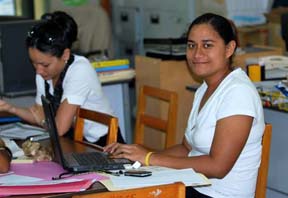 |
Emily Erasito working with youths at the Ministry
of Youth head office in Suva. |
SHE was once prepared to be scolded and criticised if anyone was upset about her awareness on HIV/ AIDS in Rotuma but Emily Erasito has never lost sight of her commitment to promote "Save Sex" instead of safe sex.
A youth advocate on her "heaven on earth" island, Emily is an example of a young leader who has advanced her community through personal endeavours.
Better known for her role as Hanisi in the Rotuman movie The Land Has Eyes, Emily continues her quest to highlight problems young Rotumans face on the island, particularly awareness programs on her Save Sex campaign.
"The hospital on the island does not have records of people walking around with HIV," she said.
"Sadly, at the end of last year we had records of STI. I feel that prevention is better than cure.
"I want to keep Rotuma a haven and a safe place against a deadly virus like HIV.
"Now that Rotuma is a port of entry, the risk of contraction is there. The probability is there.
"I'm not promoting safe sex. I'm promoting save sex. I see this awareness project as a stepping stone to greater good and productive things in future because a healthy population is a productive one.
"I believe a preventative method of HIV is A, B, C, D where D is to 'Do other things' which will not transmit the deadly virus that lead to AIDS."
Last year, she was granted funding by UNESCO under the Youth Vision program to conduct awareness programmes on HIV in Rotuma for four months.
"I talk to elders in the community about HIV but not everyone openly accepts it. But time has come and gone where everything should be behind the curtains."
Emily hails from Malsa'a in Hapmak and is a student at the University of the South Pacific.
From Fiji Times Online (29 November 2012)
Always one to help
by Solomoni Biumaiono
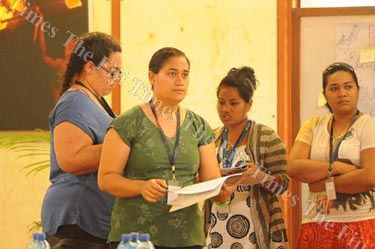 |
Emily Erasito, second left, with delegates from other Pacific island nations during a youth meeting. Picture: Jonacani Lalakobau |
As a young girl growing up in Hapmak Village on the beautiful island of Rotuma, Emily Erasito worked hard to ensure island youths had a voice and were active in village life.
A teenaged Erasito started working as a youth advocate volunteering to help with the Rotuma Youth Council in its various projects around the island.
"Whatever activities organised by the youths in our village as well as other villages I always offered my help and was part of the youth movement there until I came over to Suva in 2003," she says.
She was sent over as a 16-year-old to Fiji to finish off her education and has been actively involved in youth work apart from trying to finish her education.
Then in 2008 she was appointed by the Rotuma Youth Council to be their representative in Fiji and this set her on her way of becoming an official voice of youth advocacy in Fiji.
"I was surprised when I received a letter from the Youth Council co-ordinator explaining to me that I would represent the youths of the island here in Fiji in case none of the committee members could attend meetings in Suva.
"Later when we talked over the phone with the co-ordinator then I accepted the appointment and became part of the National Youth Advisory Board which is part of the Ministry of Youth," Erasito says.
As a Rotuma representative, Erasito explained youths on the island lack two things apart from the universal challenges faced by youths the world over.
"On our island there are two main things that need to be addressed and they are unemployment and low self-esteem," Erasito says.
She says the same can be said for Fiji where she has spent the last five years as a youth advocate and member of the National Youth Advisory Board.
"However the contexts are different but the definition of employment is definitely broader than the usual association with office work whereas planting crops to sell is a form of employment as it earns income too," Erasito says.
After gaining more experience in the National Youth Advisory Board Erasito decided to branch out and applied to UNESCO for funding through their Youth Vision Program.
She got the funding in 2009 and she used this to hold HIV/AIDS awareness workshops in all the villages on Rotuma, which is one outstanding achievement considering her young age and facing a very traditional society.
"On top of this I received life skills training from the Ministry of Health and I became a peer educator at our island. So now I was working both as a youth advocate and peer educator," she says.
Erasito spent the next two years on her island home where she worked for both the Ministries of Health and Youth raising awareness about youths and sexually transmitted diseases.
"I felt obliged to be permanently based on the island because they had given me the training and I felt I should make good use of it. Other than that, once every quarter I would travel to Suva to attend the youth advisory board meetings.
"I was at the centre of what is perhaps two issues that affect youths directly which is sexually transmitted diseases and youth development. Unfortunately things didn't work out and I had to relinquish my role as peer educator," Erasito says.
In 2010 she resigned from the Ministry of Health and in between youth advisory board meetings Erasito decided to broaden her horizon by applying to be part of the Japanese government run Ship of the World Tour.
She spent three months on board the ship where she got the chance to learn more about youth development, sustainable livelihood and youth education.
"When I returned, I went back to Rotuma where I shared my experiences with other youths on the island and then it dawned to me, with all the interest shown by our youths is that this sort of information is not readily available to those back on the island," Erasito says.
Erasito is right now part of a group of Fijian youths attending the Pacific Youth Council in Suva.
They are trying to form the National Youth Council of Fiji to make it become an official part of the Pacific Youth Council after they finalise their constitution some time soon.