|

|
From Sanimeli Maraf in Rotuma (8 March 2005; posted 31 March) Today we celebrate at Ahau International Women’s Day (IWD), which dates back to 1909 in the United States. The United Nations began observing IWD in 1975. In Rotuma this year, the theme was “Women, Peace, and Security: Women Managing Conflict.” Our guest speakers were first, the district officer, and second, Dr John Fatiaki who spoke about “Peace and security through healthy living.” Our local police sergeant spoke about “Women managing conflict.” Our agricultural speaker was unable to join us. Devotion was said by Rev Fekau Vevalesi from Malhaha Circuit; because she’s a woman preacher we were all ears and enjoyed listening to her. All the speakers were excellent and it was an educational experience to all of us women. This was the first time we have celebrated IWFD in Rotuma and there was a good turnout. Free bus rides were provided, thanks to the D.O. Unfortunately it was a wet morning to start with, so we couldn’t do the march from our Women’s Centre to the pavilion. Light refreshments were served: fekei, oranges, bananas, niu, sugarcane, pineapple, etc. Everyone went home happy and looks forward to next year. The event was organized by Mrs Seini Kauyaca and her committee. Last week, on 4 March, we were at Oinafa’s Fautarau Church celebrating the Women’s World Day of Prayer. Out new talatala, Qase’s wife, Randini Mere, started the service. The Oinafa and Malhaha circuits prepared lunch. It was a good opportunity for women of different churches to take part in such a celebration. The event will be held in Losa next year. The CMB is leaving Suva this Saturday, so we are looking forward to a fresh supply of groceries and fuel, but we still have fresh bread from Kafoa Olsen’s bakery in Malhaha. From Katarina Lucas in Fiji (30 March 2005) 'E rån 10 ne Maji, lä'riri' ma ma'ma'piag
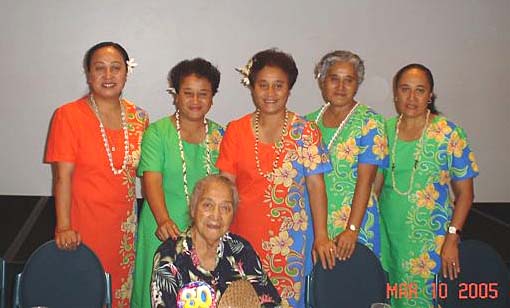
'on Hiagi 'Apao Titifanue a'sok 'on fau volaghulu (80). Terån
ta kamat 'e rotu, 'ua'ua'akia ma voivoi'akia Gagaj 'Aitu 'e mata'
ma åf'åk ne mäür ne 'otomis ö'hön/ma'piag
te'is 'e laloag ne fau volaghul 'atakoa. Rot ta a'sok 'e Churchward
Chapel, Fekau Iven Fatiaki ta a'sokoa rot ta. Rot ta våh ma
gagaj 'atakoa ne hele'uof po ma te ag 'esea 'e ta 'amah/'ate ianine
'e ri 'on Räve ma Alfred Tua'toko, Muanikau. 'E pög ta'ag,
av ne he on heta, 'amis 'op hoi'åk se Holiday Inn la a'sokoa
ta 'omoe, mak ruerue ma mutua kek het ne mou se terån a'su
ta. Gagaj 'Aitu noa'ia ma haiasoag ma 'amnåk ne terån
ta po ma a'sok a'lelei.
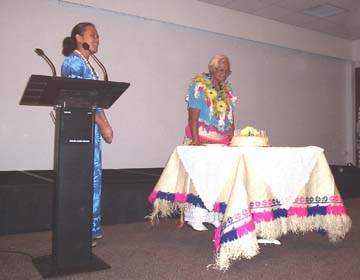
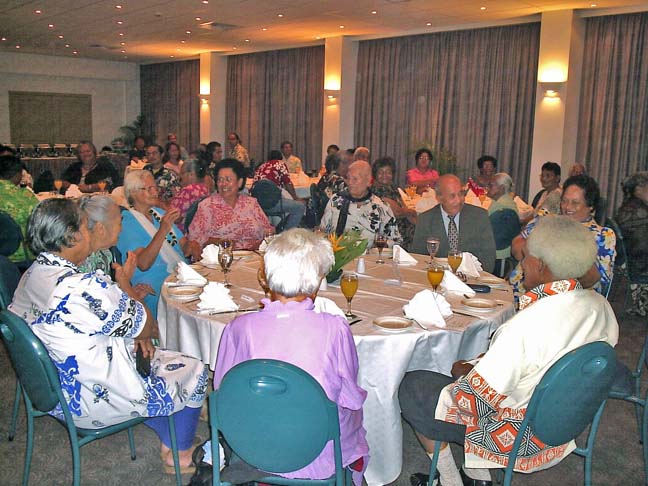
From Betty Cokanasiga in Suva (28 March 2005) Elizabeth (Elisapeti) Kafonika Inia celebrated her 80th birthday with family, friends, colleagues, children she and husband Wilson adopted, and admirers at the Lali Room of the Holiday Inn in Suva on 18 March. Dr. Sukafa Tevita, her eldest grandchild, acted as Master of Ceremonies for the evening. The program began with the first adopted "son" she and Wilson brought up, Reverend Inoke Nabulivou, who came from Perth, leading the devotion with Reverend Jione Langi, their second adopted “son.” Reverend Inoke is a former president of the Methodist Church and Reverend Langi is the current president. The third adopted member of the household and sigoa (Lisi Mario) performed the traditional osi for Elisapeti – tofua and tefui.
Daughter Betty Cokanasiga greeted the guests and introduced the speakers. She referred to her mother as the light from the lamp that is placed on a lampstand for the world to see her good deeds and praise our Father in Heaven (Matthew 5:14-16). Deaconess Olovia then spoke about Elisapeti’s life and contributions to Rotuma and Fiji, followed by Jioje Fonmoa, who spoke on behalf of the many children and grandchildren she and Wilson brought up. Granddaughter Sukafa contributed a moving and personal testimonial on behalf of the grandchildren. Toward the end of the dinner, M.P. Marieta Rigamoto read tributes sent in absentia from Vilsoni & Jeannette Hereniko and Alan Howard & Jan Rensel and made her own contribution.
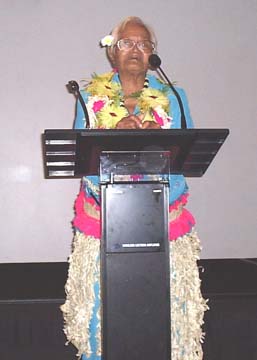
Dr. John Fatiaki first related his interesting encounter with his Aunt Elsapeti when he was almost run over by her motorbike during the filming of Pear ta Ma ‘On Maf and then proposed a toast in Elisapeti’s honour. Daughter Susana brought on an entertainment group from Sun Yat Sen school, where she is principal. The multicultural items were very refreshing. After dinner Mrs. Inia spoke for almost an hour and proclaimed this day as the happiest of her life. During this talanoa or hanuju session, some funny stories and experiences from the past were related. Her strong paternal links to the Catholic community who were also represented was also mentioned. Finally, son Savea thanked the guests for coming and all those who made the occasion possible by their contributions, and Reverend Langi offered a concluding prayer.
From Alan & Jan in Honolulu (25 March 2005) Vilsoni and Jeannette Hereniko's feature film, The Land Has Eyes, continues to get rave reviews from critics and has proved extremely popular with theatrical audiences. It opened to general audiences at the Dole Cannery Theaters in Honolulu, with five screenings a day, on Friday, 11 March and has been held over twice, until at least 7 April. The film is scheduled to play at festivals or at special screenings in Ashland and Portland, Oregon; in Los Angeles; in New York City and Washington D.C. in the next two months. For information concerning the scheduling of screenings go to The Land Has Eyes website. Below are links to several recent stories about and reviews of The Land Has Eyes.
From John Muaror in Sydney (22 March 2005) The Motusa Reunion Tour
The tour was organised by Pat and Marseu Faktaufon and the Motusa Suva Group, with friends from Vatukoula, Nadi, and Lautoka participating as well. People were talking about the tour throughout 2004 and were excited about it, those from Motusa village and those from elsewhere. Not to forget friends from Sydney (including the Lalavi Group and families), Melbourne, and New Zealand. Altogether about 400 people were involved in the tour, a record for the books. The Sinu-I-Wasa left Suva wharf on Friday morning, 17 December, and arrived at Rotuma on Saturday night. Unfortunately, we had to wait till Sunday morning to disembark, but the wait was no big deal. We were there safely and that was the most important thing.
Overseas visitors were first off the boat, followed by those from Suva. Many thanks to Dr. John Fatiaki and a few other locals with launches who assisted in the transportation of passengers to shore. It was well organised and the four or five launches completed the task quite quickly, with only one hiccup--when Pat`s launch started to fill will water approaching the shore and a couple of boys had to jump off and swim the rest of the way. It caused a bit of laughter among those on shore but it was all fun, fun, fun. I was amazed that none of the hundreds of suitcases, boxes, bags, sleeping bags etc. was lost or stolen. The highlight of the tour was the kato’aga held a couple of days later to celebrate the installation of the electricity generator the Motusa folks worked so hard to buy. It was a beautiful sight to see homes lit and street lights turned on right throughout Christmas. It was an awesome sight according to locals.
The host group danced first followed by the Suva group, whose music and choreography were prepared by Marseu and Maggie. It was exciting and entertaining and in fact most of their songs were sung during Christmas fara all around the island. There were also island action songs by Lily and friends from Suva, followed by Rosarine`s group from New Zealand, including Darlene and Moana. For three weeks there was a lot of activity at the camp inside Motusa Primary School grounds. Music, singing and dancing, could be heard till the wee hours of the morning, not to mention the constant pounding of grog and partying, which kept our neighbours awake sometimes.
And of course there were the fara trips around the island, journeys to Afgaha and Hatana, visits to popular spots such as Lulu and "Ana te Siliga," to name a few. There were also invitations to weddings and church services in other villages. The trip was a great success, thanks to Pat and Marseu, Sukamanu and Marie, Marseu and Maggie, and of couse our hosts in Rotuma: The late Gagaj Tukagsau; Gagaj Markao, chief of Itu'ti'u; Gagaj Reauas; and the current Gagaj Tukuagsau, who spent countless hours preparing koua food for everyone. Thanks also to those not mentioned who helped in any way, and to friends and relatives who visited (la' asi) the camp in the traditional way. May the Lord Our Heavenly Father continue to bless Motusa in years to come, and lights continue to brighten up homes and lives in paradise. From Frank Samuela in New Zealand (21 March 2005) The following letters were extracted from the Fiji Times Online website. The first extract was taken from the Fiji Times for Saturday, 19 March 2005 and the second extract is from the Fiji Times today. Both are letters to the Editor. Letter 1: Rotuman contribution SINCE the 1987 coup, government policies are formulated to favour Fijians and Rotumans. It was a political ploy by the coup plotters and it needs to be reviewed. The focus should be on Fijians and Indians instead of Fijians and Rotumans. Before 1987, the late Ratu Mara's policies focused on Fijians and Indians. I think we should go back to the days of Ratu Mara because his policies were good. Rotumans have hardly contributed anything to Fiji, compared to Indians, and are a huge cost to the nation. We should get Ratu Mara's policy of a Fijian-Indian partnership back because it is important for the two races to unite. The nation is suffering because the two races are divided. Once the two communities are united the rest will fall into place. Tomasi Baleiwai Commentaries by Henry Enasio, Akata Hodgkinson, and Fuata Jione * * * * * * * * * * * * * * * * * Letter 2 in Response to Letter 1: Rotumans' contribution (21 March 2005) I would like to reply to Tomasi Balewai (FT 19/03). If his view is that Rotumans do not contribute to Fiji's economy, he needs to get his facts right. Our contribution maybe little but its a contribution nonetheless. As a Rotuman, I am indeed offended with his letter. It's such narrow-minded people who create more discord in Fiji. Why attack the Rotumans if he wants the Government to focus on the 'Fijian and Indian' relationship? It is not our fault that we Rotumans are mentioned together with Fijians in almost all scholarships, grants, and other benefits. We are indeed grateful to be part of Fiji but we do not go proclaiming that we contribute a lot to the economy. Mr Tomasi needs to be reminded of that statement that "each individual is important to any community no matter how small their talents and gifts, and scope of knowledge maybe". Or maybe he should just focus on the Fijians and Indian relationship and leave any mention of Rotumans out of the picture. He further mentions the late Ratu Mara's policy of a Fijian and Indian relationship. I have never heard the late Ratu Mara mention anything about Rotumans contribution to the economy. I suggest to him that if this attack on Rotumans is a personal one! than deal with it personally. Selina Rigamoto Letter 3, in response to Letter 1 (22 March 2005) Fiji and Rotuma I REFER to Tomasi Baleiwai's letter (FT 19/3). I disagree with his view that the 1987 coup plotters formulated policies which favoured Rotumans more than Indians instead of Ratu Mara's pre-coup policies focusing on Fijians and Indians. I believe that in Ratu Mara's time, Rotumans were silently included under Fijians (we have no complaint about that) and that the coup plotters have not focused more on Rotumans than Indians but more important, they declared more vividly the status of Rotumans as indigenous landowners of this country, however small we may be. Mr Baleiwai said Rotumans hardly contributed anything to Fiji, compared to Indians, and were a huge cost to the nation. Rotumans have done their best for this country. We will continue to do so because of our love for God's creation, our very strong and real ethnic ties with Fijians and our religious and administrative connections ever since the 19th century, with Fiji. As for the huge cost, I beg to be given time to work out how our smallness has been costly to the country. I assure Mr Baleiwai that we Rotumans remain firm in our work to attain an image of being on par with others in our contribution despite our being "small". Marieta Rigamoto From Malagrani (nee Mani) Smith in Sydney, Australia (19 March 2005) Honouring Deaconess Olovia Nataniela This item has been transferred to the Life Stories section of the website From Fiji Times Online (16 March 2005) Alfred Taito follows his destiny This item has been transferred to the Life Stories section of the website From Fiji Times Online (14 March 2005)
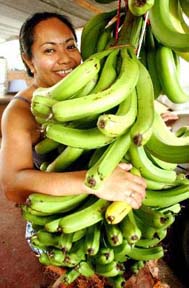
IT is the biggest bunch of bananas most people in the area have ever seen, according to 46-year-old Sopapelu Samisoni. After two years of growing a sucker given by a friend, the Samisoni's banana tree bore the biggest fruit they had ever set eyes on. As long as Jane Samisoni's arm from elbow to tip, the fruit dwarfs others of the same variety. "We have the same kind of fruit in Rotuma but this is extraordinary," Mr Samisoni said. "These are huge. In Rotuma we call it van-vani." Mrs Samisoni said the bunch of bananas was so heavy it almost touched the ground. "We had to use a stick to brace the plant because the bunch of bananas was too heavy. Also we did not want to damage the plant," she said. Friends and neighbours have been visiting the home in Caubati Road to marvel at the size of the fruit. Some have already asked for suckers to plant in their own homes. From Alan & Jan in Honolulu (11 March 2005) Vilsoni and Jeannette Hereniko's feature film, The Land Has Eyes, is now showing for general audiences in Honolulu at the Dole Cannery Theaters, for a limited engagement. Last evening there was a special screening for the local Rotuman community and for others who have contributed in one way or another to the production of the film, which has now been converted to 35 mm. Seen in 35 mm on a large screen, the film is even more stunning and spectacular than before. In addition to receiving awards at film festivals, The Land Has Eyes has been getting rave reviews from critics. Here are links to three recent reviews:
From Walter Aitu in Laie, Hawai‘i (7 March 2005)
This note is to let Rotumans around the world know that there is a small Rotuman community growing at Brigham Young University--Hawai‘i. When we meet and speak in Rotuman it reminds us of the island back home and the times when we were there. Most of us are sponsored students by The Church of Jesus Christ of Latter-Day Saints on a work and study program that allows us to work nineteen hours a week and study. Most of us work at The Polynesian Cultural Centre at tasks ranging from cleaning to cooking to guiding tours to dancing. It is a unique place in Laie, Hawai‘i that preserves and displays the cultures of Polynesia (Hawai‘i, Tonga, Samoa, Fiji, New Zealand and Tahiti). This is an invitation to any Rotuman who is planning to stop by in the future. Just contact Walter Aitu (808) 275-4589, elsio1@byuh.edu or hafleua@yahoo.com and I will arrange something for you! From Boxing-Central.Com (7 March 2005) At Saturday's Heavyweights Night Out show at Unitec Stadium, in Auckland, N. Z. Frank Atu of Rotuma Island won the heavyweight eliminator competition in a final with Richard Tutaki. Atu was clearly the victor, thanks to his superior work rate and accurate punches, most of which landed flush on Tutaki's head. Tutaki had earlier impressed with a points victory over former amateur star Sam Leuii, while Atu had beaten experienced heavyweight Vai Toevai on points.
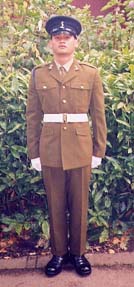
News from Bruce Tizard-Varcoe in England (4 March 2005) Emmanuel Lilino, son of Alfred and Harieta, has successfully passed his Phase 2 British Army training course. He is currently undertaking a driving course before joining his regiment (The Royal Signals), in Wales, as an electrician. He arrived in the U.K. from Fiji on 10 July 2004 and completed Phase 1 training on 7 October, winning the prize for "Best Recruit".
|
|